

Georgia tried to look positive. “So, how do you think your lessons have been going so far?”
Her headache heightened as she listened to his justification of the train wreck. The glaring problem of disorganized and underdeveloped lesson plans didn’t come up.
“I think the top thing we can be focusing on right now is your lesson planning.” She opened his logbook to the lesson plan that day and pointed to the most obvious flaw: Do practice problems on the board.
“Did you decide beforehand which practice problems you were going to do?”
“Well, I know the content, so it’s easy to come up with on the spot.

“Next time, I’d like you to try fleshing out your lesson plan a bit. Think about what you learned in your Curriculum and Instruction class.”
It might’ve been easy, Georgia thought, but it removed the opportunity for strategic chunking and scaffolding of concepts.
Week 1

Driving home, she wondered if he was right. Then she answered herself: “Yes! Because his lesson plans are affecting his teaching.”

Week 2
The night before their next observation, Georgia received Carlos's lesson plan. It was longer than before but still lacked organization, and the next day's lesson left students confused.
While Carlos helped the class, Georgia spoke with the classroom teacher.
“He's been showing you his lesson plans beforehand?”
“Of course,” Ms. Vlad replied. “He's working hard. I think he just needs more experience recognizing where students get confused. My lesson plans are much simpler than what the university expects.”
After the debrief, Georgia overheard Carlos venting.
“All she ever does is harp on my lesson plans!”
Georgia realized Carlos saw lesson planning as a university requirement instead of a teaching tool.
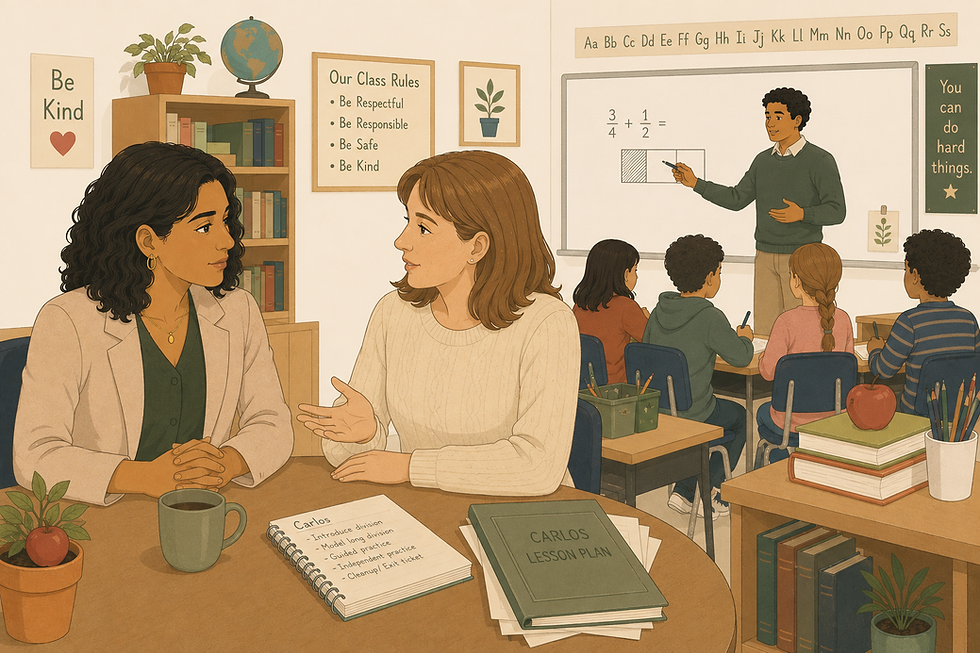
Her challenge wasn't convincing him to write more, it was helping him see that thoughtful planning helps teachers organize instruction, anticipate misconceptions, and support student learning.

Week 3
This time, Georgia set Carlos's lesson plan aside and simply observed the lesson.
During the debrief, she asked, “What skills did you teach today?”
“Dividing fractions.”
“Break that down for me.”
As they unpacked the lesson together, Carlos realized that what he had thought was a single skill actually involved several prerequisite concepts. Together, they reorganized the lesson into Review Background Skills, Teach New Skill, and Extension/If Time, sequencing the learning more intentionally.
When they finished, Georgia held up the page.
“What if this had been your lesson plan?” she asked. “Do you think today's lesson would have gone differently?”
Carlos paused.
For the first time, he understood that lesson planning wasn't about completing a university assignment, it was about intentionally designing learning so students could succeed.

Reflection Questions

1
1
What different assumptions do Carlos and Georgia hold about lesson planning and effective teaching? How do these differing assumptions contribute to the tension between them?
What different assumptions do Carlos and Georgia hold about lesson planning and effective teaching? How do these differing assumptions contribute to the tension between them?
Why might repeated feedback on the same issue feel discouraging to a mentee? How can mentors revisit ongoing concerns without creating defensiveness? What strategies does Georgia use in Week 3 to make her feedback more empowering?
2
2
Why might repeated feedback on the same issue feel discouraging to a mentee? How can mentors revisit ongoing concerns without creating defensiveness? What strategies does Georgia use in Week 3 to make her feedback more empowering?
How does Georgia connect lesson planning to student learning rather than university requirements? How would this impact the way the feedback is received?
How does Georgia connect lesson planning to student learning rather than university requirements? How would this impact the way the feedback is received?
3
3
4
At what point does Georgia realize her current mentoring strategy is not working? What does this case teach about flexibility in mentorship?
At what point does Georgia realize her current mentoring strategy is not working? What does this case teach about flexibility in mentorship?
4
5
Where do you see Georgia moving along multiple dimensions simultaneously?
Where do you see Georgia moving along multiple dimensions simultaneously?
5
6
Georgia's breakthrough occurs when she stops explaining and starts helping Carlos analyze his own teaching. What does this case teach us about the role of reflection, dialogue, and guided discovery in effective mentorship?
Georgia's breakthrough occurs when she stops explaining and starts helping Carlos analyze his own teaching. What does this case teach us about the role of reflection, dialogue, and guided discovery in effective mentorship?
6
Reflection Questions